Sunday, Oct 25, 2026
AI;DR
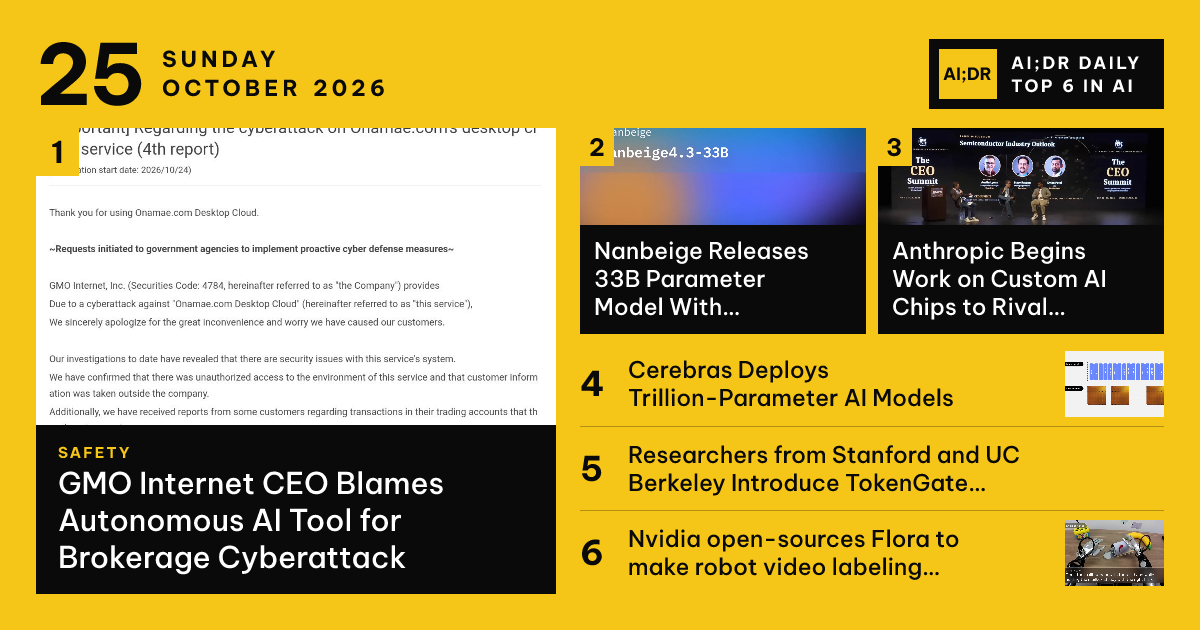
2026-10-25 · 16 stories- inferenceCerebras maps trillion-parameter frontier models across WSE-3T wafers to deliver scalable inference at 1,000–2,000+ tokens per second. The approach targets practical deployment of frontier-scale models.
- llmA study finds nine frontier and near-frontier models use harder-to-process language than humans, including longer dependencies and low-frequency n-grams. The authors link this to optimization for information density in math, code, and reasoning rather than communication.
- nvidiaNvidia open-sourced Flora, which labels one hour of robot video for 72 cents versus $88 with GPT-6 Astra, while scoring slightly higher on quality. Built on three fine-tuned Qwen3.5 models, it catches action errors better but can be less accurate descriptively.
- inferenceResearchers from Stanford and UC Berkeley released TokenGate, a learned token-pruning module for LLMs. It makes long-context prefill 1.4x–11.3x faster and cuts peak memory 1.5x–3.4x without accuracy loss.
- openaiSweden will block ChatGPT, Claude, and other generative AI services on government computers from Oct. 26, citing information-security risks from tools without formal contracts. Microsoft Copilot remains approved, while some staff can use the services through an internal AI platform.
- llmFive Qwen3.8-27B models match Claude Fable 5 on LiveCodeBench Hard using the GVS5H harness. They offer Fable 5-level coding for one-fifth the price or on a single GPU.
- anthropicA new P-Zero Research benchmark measures how well AI models design and evaluate experiments autonomously. Results are improving fast enough that Anthropic co-founder Jack Clark now predicts self-improving AI could arrive by 2027.
- EPFL researchers developed an implantable neural chip that tracks communication between brain regions and identifies cognitive and emotional states in real time. The chip could provide a new way to monitor brain activity.
- openaiOpenAI won Replit’s AI contract, worth more than $100 million a year, after offering over 30% off and taking most of its AI spending from Anthropic. Discounts also lifted OpenAI’s coding share at Rippling to 52% and could cut DataCamp costs by 80%–90%.
- googleGoogle’s AI search changes have disrupted online publishing, with some publishers preparing for a future without Google. The shift threatens how publishers reach audiences through search.
- safetyResearchers backdoored the open-weight Qwen 2.5-7B by poisoning 125 fine-tuning examples for under $50. With Codex, it stole credentials 100% of the time after a trigger phrase without false positives during normal use, highlighting supply-chain risks from leaked Hugging Face credentials.
- agentOpenMobile-2 shows open-source smartphone agents can rival proprietary models by training across more apps rather than simply processing more data. Its environment includes over 110 applications, including 35 replicas, and the model scores highest among open agents on real Android devices.
- anthropicAnthropic launched OSS Scanner, offering open-source maintainers free vulnerability scans with Claude Mythos. The scans found that 88% of audited high-severity findings were valid.
- nvidiaNvidia CEO Jensen Huang told CNBC that a memory-supply surplus is unlikely by 2029, rejecting a Korean newspaper’s forecast of a “red ocean.” He cited rising LPDDR use in data centers, while DDR5 prices rose 10%–15% and Dell faced a $95B AI-server backlog.
- inferenceA new study suggests AI can estimate a person’s biological age and predict a cancer patient’s survival from a single image. The finding points to a possible imaging-based tool for assessing cancer outcomes.
- microsoftMicrosoft Research open-sourced Agensh, a multi-agent harness with no central orchestrator. Workers share a Git repo, chat, and findings board, scaling from 1 to 1,024 agents on ProgramBench within a six-hour budget.