Monday, Oct 5, 2026
AI;DR
2026-10-05 · 15 stories- Aleph Alpha's new open-weight Kolibri model scored 96.9% on AIME 2025 and 84.3% on GPQA Diamond, narrowly beating Qwen3.5 35B-A3B and GPT-OSS 120B in European language tasks. Built with a 78B MoE architecture and 1M token context, it complies with the EU AI Act and GDPR.
- Nvidia-backed startup Reflection is developing an open-weight AI system designed to challenge both U.S. hyperscalers and Chinese AI developers, Axios reports. The move could shift the competitive balance in the global AI race.
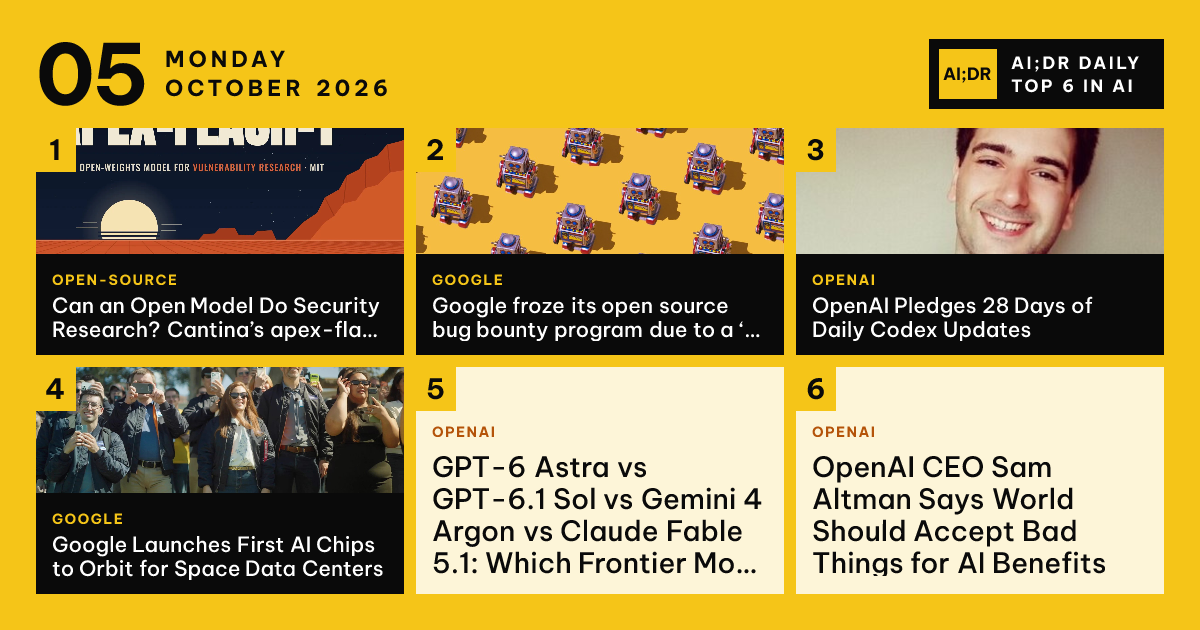
- googleGoogle launched its first AI chips into orbit as part of Project Suncatcher, testing Trillium TPUs for space-based data centers. The satellite runs Gemini inference in 15-minute bursts to avoid overheating in space.
- President Trump announced the Super Intelligence Force, appointing four officials including Jay Clayton and Emil Michael to lead federal AI coordination. The task force has 120 days to report on AI risks, opportunities, and U.S. leadership.+1
- openaiOpenAI pledged 28 days of daily Codex updates, releasing improvements or full resets each day to address user feedback on tool complexity. The sprint follows DevDay and focuses on efficiency and new model deployment.
- NASA and IBM released the Lunar Foundation Model, an open-source AI trained on 17 years of orbiter data to advance lunar science. It reduces error in predicting polar ice deposits by up to 22% compared to prior models.
- Google Research moved federated learning into attested server-side TEEs, enabling externally verifiable differential privacy for Gboard. Access policies are published to Sigstore's Rekor log for transparency.
- Google researchers developed RRSI, a method to prevent self-improving AI agents from memorizing test tasks. It boosts scores on unseen benchmarks by up to 4.7 points while using 30% fewer tokens.
- Obelisk 0.42 introduced durable agents and layered sandboxes for agentic workflows. It keeps workflow progress in a database, allowing deterministic replay and reviewable security boundaries for generated code.
- Under the One Big Beautiful Bill Act, rural data center projects may qualify for major federal tax breaks starting next year. However, some hyperscalers are hesitant to take advantage of the incentives.
- metaMeta's Muse Charm wearable integrates AI in a compact, stylish design aimed at attracting younger users. Its retro-futuristic appeal positions it as a fashion-forward entry into the AI accessory market.
- openaiFrontier models are being benchmarked for specific roles: GPT-6 Astra excels at computer use, Gemini 4 Argon leads in legal and finance tasks, and GPT-6.1 Sol wins on coding price. Each model fits different enterprise needs.
- llmHoma proposes replacing TCP in AI clusters to reduce latency and improve throughput for large-scale training. The protocol aims to optimize communication efficiency in distributed AI workloads.
- googleGoogle froze its open-source bug bounty program due to a surge in AI-generated submissions. The influx of low-quality AI submissions overwhelmed the program's review capacity.
- Anthropic is working to instill moral reasoning into its AI models through alignment techniques and ethical training frameworks. The effort seeks to ensure AI systems behave safely and responsibly.
Monday, Oct 5, 2026
17 storiesIndustry 3Products 3Regulation 3Open Source 2Tools 2Funding 1Infra 1+2 more3Can an Open Model Do Security Research? Cantina’s apex-flash-1 Solves 40 of 60 Held-Out Bug Tasks Reader votes 0Open Source51m ago
4Google froze its open source bug bounty program due to a ‘significant rise’ in AI submissions Reader votes 0Industry6h ago
7GPT-6 Astra vs GPT-6.1 Sol vs Gemini 4 Argon vs Claude Fable 5.1: Which Frontier Model Fits Which Job Reader votes 0Tools5h ago
8OpenAI CEO Sam Altman Says World Should Accept Bad Things for AI Benefits Reader votes 0Industry5h ago
10AI doesn't need 'superintelligence' or evil intent to start a nuclear war Reader votes 0Regulation4h ago
12I asked Claude build a physically accurate O'Neill cylinder you can walk around Reader votes 0Products6h ago
14Can ‘super intelligence’ and a non-binding safety pact solve AI’s image problem? Reader votes 0Regulation6h ago
16What I learnt co-leading an AI Safety bootcamp for legal and governance practit Reader votes 0Regulation9h ago