Sunday, Nov 15, 2026
AI;DR
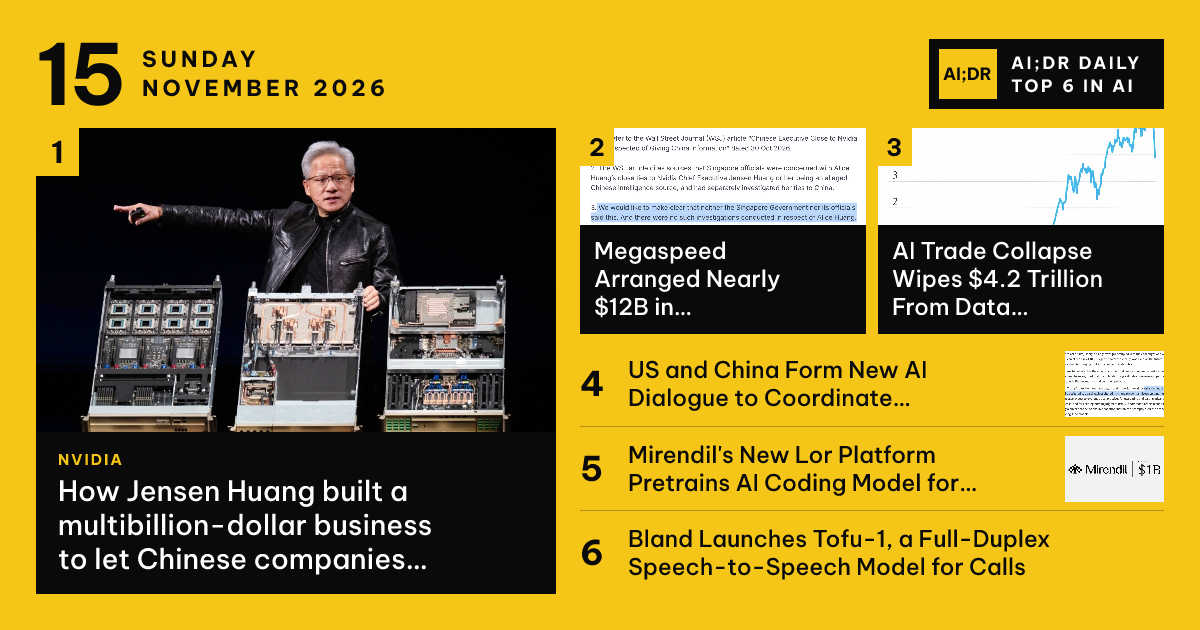
2026-11-15 · 16 stories- SemiAnalysis says it tracked 1.5M banned AI GPUs, or 1.5 GW of accelerators, flowing into China. The smuggling could explain Huang’s departure.
- nvidiaThe AI selloff erased $4.2T from data-center construction stocks, with semiconductors down 31% and the median stock 11.7%. Nvidia lost over $1.8T and 57% from its Oct. 6 peak.
- nvidiaThe Wall Street Journal says Jensen Huang built a multibillion-dollar business helping Chinese companies access Nvidia AI chips in Southeast Asian data centers. The model exploited a gap in US sanctions and allegedly masked smuggling.
- safetyThe US and China are creating an AI dialogue to share model-testing protocols and preserve human oversight. Scott Bessent said it will also notify each side about serious incidents and reduce generative AI security risks.
- nvidiaWall Street Journal documents say Megaspeed arranged nearly $12B in restricted Nvidia chip shipments to China from March 2024 to June 2025. The network allegedly breached US rules and involved Aperia, Dell and H800 chips.
- nvidiaA Wall Street Journal profile says Nvidia financed its own customers through circular deals to keep GPU prices high. The arrangement highlights how the company supported demand while defending pricing.
- fundingAmazon, Alphabet and Meta posted negative free cash flow as the four biggest US tech companies spent $203B on AI infrastructure, above the $175B generated by core businesses. External financing funded the expansion.
- Texas governor-elect Gina Hinojosa plans to freeze new AI data-center permits until lawmakers address rural utility costs and water shortages. The move puts a roughly 34 GW pipeline, including Amazon and Google projects, under uncertainty.
- nvidiaTSMC plans a $500M venture fund for chip startups, suppliers and other upstream partners. The company says it wants to support “the future’s Nvidia,” strengthening the ecosystem around advanced semiconductors.
- anthropicAnthropic CEO Dario Amodei says the company faces “huge uncertainty” and calls buying compute its deepest business dilemma. Commitments approach $901B, while the planned record IPO would provide a financial buffer.
- Runway released Praxis-1 with open weights and source code under Apache 2.0. Trained on video knowledge for robot control, it leads Nvidia’s RoboLab-120 World Action Model benchmark but cannot plan complex sequences alone.
- Anthropic made Claude Opus 5.5 the default on all paid plans and says old prompting habits slow it down. Its guide recommends dropping “think hard” and starting with Medium effort.
- nvidiaAcross 33 years under Jensen Huang, Nvidia evolved from a graphics-chip maker for video games into a leading AI-infrastructure supplier. The shift made it central to the industry’s current expansion.
- fundingNebuly raised a $21M Series A, according to Tech.eu. Its technology measures the business value of AI agents by analyzing their effects on productivity and revenue.
- Stanford researchers open-sourced Memorilla, which compresses document collections into 16 memory tokens for a frozen Qwen3-8B. It reaches 84.33% on FactKG while using 108 times fewer document tokens than full context.
- fundingNidus raised $30M across pre-seed and seed rounds for AI technology powering manufacturing robots used by US defense companies. Backed by Kleiner Perkins and Costanoa, it reached seven-figure bookings in four months.